0%

Pallet Rack Systems determine how goods are stored, reached, and moved through a warehouse. The right design can make better use of floor space, support smoother picking, and keep inventory visible. But “more storage” is not always the same as “better storage.” A dense layout may reduce aisle space, while a highly accessible one may hold fewer pallets.

This guide introduces ten common types, including selective, double-deep, drive-in, drive-through, push-back, pallet-flow, cantilever, mobile, carton-flow, and automated storage systems. Each works differently. Some give forklift operators direct access to individual pallet positions. Others rely on deeper lanes, gravity, or powered equipment to move goods. Small details matter: pallet dimensions, load weight, forklift turning space, stock rotation, and ceiling height can all change which option fits. That sounds simple. It rarely is.

The comparisons ahead focus on practical trade-offs, not just rack names. For example, a drive-in system can store many pallets in a compact area, but retrieving one specific pallet may take more planning. A selective system offers easier access, yet often needs wider aisles. Treat these points as a starting place, not a final design. Actual capacity and safety depend on the rack specifications, floor conditions, installation, and operating practices. A qualified storage-system professional can assess those details before a warehouse commits to a layout. Even a careful plan can miss something; real workflows sometimes reveal the gap.
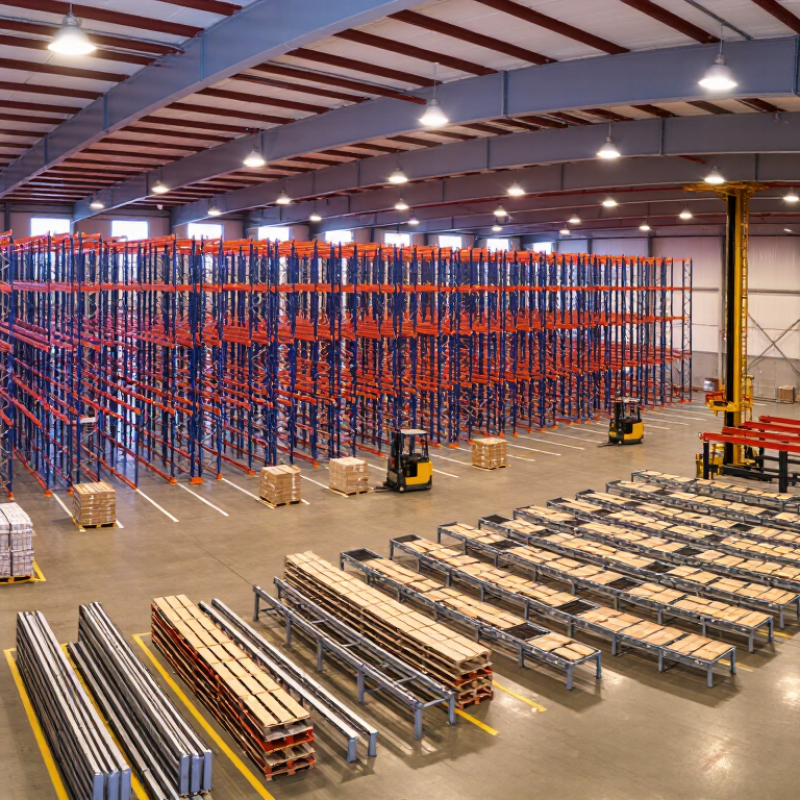
What Are the Top 10 Types of Pallet Rack Systems?

Core Components and Operating Principles of Pallet Rack Systems

A pallet rack is a load path, not just a row of steel. Upright frames transfer weight to the floor; horizontal beams carry pallet loads, while diagonal braces keep frames square. Decking supports pallets between beams, and anchors resist movement at the base. Small details matter. Beam connectors must lock securely, and damaged uprights can change how loads travel through the structure. RMI’s ANSI MH16.1 standard covers the design, testing, and use of industrial steel storage racks; capacity depends on the rack’s configuration, not simply its appearance.

Operating principles vary by layout. Selective racks offer direct access to each pallet, while drive-in systems trade access for denser storage. Pallet-flow racks use inclined rollers to move loads toward the picking face; push-back racks typically serve the last-in, first-out sequence. Load labels should match the installed beam spacing and configuration. They are not decoration. The U.S. Bureau of Labor Statistics reported 4.8 recordable injury and illness cases per 100 full-time workers in warehousing and storage in 2022, a reminder that clear aisles and careful handling matter around racks. In practice, inspection routines can miss small impacts behind stored pallets. That is worth reconsidering.

The 10 Main Types of Pallet Rack Systems

Pallet rack selection starts with the inventory, not the rack itself. Selective rack gives direct access to every pallet, but uses more aisle space. Double-deep rack stores pallets two positions deep and needs compatible reach equipment. Drive-in rack supports dense, last-in, first-out storage. Drive-through rack allows access from both ends, which can support first-in, first-out handling.

Push-back rack stores pallets on nested carts; each new pallet moves the earlier one backward. Pallet-flow rack uses rollers and gravity to move loads toward the picking face. Shuttle rack uses a powered cart inside deep lanes, reducing forklift travel. Mobile rack moves on floor-mounted bases, opening an aisle only where needed. Handy, but the moving structure and controls need careful planning.

Cantilever rack has open sides and arms for long or irregular loads, such as lumber or tubing. Structural rack uses heavy structural steel components and can suit demanding applications. These ten systems solve different storage problems; none is best for every warehouse. A narrow aisle may save floor space, yet slow daily picking. Check pallet dimensions, load weights, equipment clearances, and building constraints with a qualified rack professional. Small details matter. Even a tidy drawing can miss a turning clearance.

What Are the Top 10 Types of Pallet Rack Systems? - The 10 Main Types of Pallet Rack Systems

Pallet Rack System Access and Selectivity Typical Inventory Rotation Storage Density Common Applications Key Consideration
Selective pallet rack Direct access to each pallet position Flexible; supports FIFO or LIFO handling Low to moderate Warehouses with many product types and frequent picking Easy access, but aisle space can limit capacity.
Double-deep rack Access to the front pallet; a second pallet sits behind it Usually LIFO within each two-deep lane Moderate to high Operations with multiple pallets per product and fewer SKUs Typically requires a deep-reach truck and reduces direct access.
Drive-in rack Forklifts enter the rack lane to load and retrieve pallets LIFO High Large quantities of the same product, including some cold-storage uses Fewer aisles save floor space, but access to individual pallets is limited.
Drive-through rack Forklifts can enter lanes from both ends Can support FIFO when loading and retrieval occur at opposite ends High High-volume, lower-SKU operations that benefit from two-sided access Requires access aisles at both ends of the rack lanes.
Push-back rack Pallets are loaded and retrieved from the same aisle LIFO within each lane Moderate to high Multiple pallets per SKU where compact storage and quicker access than drive-in are useful Pallets move on inclined carts or rails, so load dimensions and condition matter.
Pallet flow rack Loads in from one end and are retrieved from the other FIFO High High-throughput goods with date-sensitive stock rotation Gravity rollers or wheels move pallets; lanes need suitable, consistent loads.
Pallet shuttle rack A powered shuttle moves pallets within deep lanes; forklifts stay at the lane entrance FIFO or LIFO, depending on lane configuration and operating method High High-volume storage with deep lanes and repeated pallet handling Requires shuttle equipment, compatible pallets, and system coordination.
Mobile pallet rack Racks move to open one operating aisle at a time Direct access to stored pallets when the required aisle is open High Space-constrained facilities and some temperature-controlled storage Moving bases need suitable floor conditions and safety controls.
Narrow-aisle rack Pallet positions remain individually accessible through narrower aisles Flexible; supports direct access to a wide range of SKUs Moderate to high Facilities seeking to increase storage while retaining selective access Usually needs specialized narrow-aisle trucks and careful aisle planning.
Structural pallet rack Typically provides selective access, depending on the layout Depends on the rack configuration; FIFO or LIFO may be possible Varies by layout Heavy-duty applications or environments where structural steel framing is preferred Capacity and design must be matched to loads, equipment, and applicable safety requirements.

How Rack Types Differ in Storage Density and Selectivity

Storage density and selectivity often pull in opposite directions. Selective pallet racks offer direct access to every pallet, but require more aisles and use floor space less densely. Double-deep racks store pallets two positions deep, gaining capacity while limiting access to the rear pallet. Drive-in racks use fewer aisles and suit large batches of similar goods; most operate last-in, first-out. Drive-through racks allow entry from both ends and can support first-in, first-out handling. That difference matters.

Push-back racks store several pallets deep and retrieve them from the same aisle, usually in last-in, first-out order. Pallet-flow racks use inclined rollers for first-in, first-out movement, while carton-flow racks serve smaller cases rather than full pallets. Pallet-shuttle systems move loads within deep lanes, reducing forklift travel inside the rack. Mobile racks move on floor rails to open an aisle only where needed. Cantilever racks support long, awkward items, not conventional pallet loads. Each design trades access for capacity differently.

A warehouse handling many product codes may favor selective racks, even when storage density looks modest on paper. A facility holding fewer, uniform items may gain more from deep-lane systems. Check pallet dimensions, turnover, forklift reach, and replenishment patterns before choosing. A plan can look efficient in a drawing and feel clumsy during a busy shift. Real traffic is messy. Flow racks also need compatible loads and careful maintenance; rollers do not fix poor inventory rotation by themselves.

How to Match a Rack System to Inventory and Facility Needs

Matching a rack system begins with the inventory, not the aisle layout. Record pallet dimensions, loaded weights, SKU counts, and how often each item moves. Fast-moving goods often suit selective racks, which offer direct access to every pallet. High-volume storage with fewer SKUs may use drive-in or push-back racks to gain density.

Consider how stock rotates. Pallet-flow racks can support first-in, first-out movement, while push-back systems typically store pallets several deep. Double-deep racks add capacity but require compatible handling equipment. For long loads, cantilever arms may work better than standard beams. Carton-flow shelves can bring small items closer to picking staff.

Mobile racks reduce fixed aisles. Narrow-aisle designs use floor space efficiently, but need suitable trucks. Mezzanines add usable levels when building height allows.

Trade-offs are real.

Then check the facility itself. Measure clear height, aisle widths, column spacing, door locations, and sprinkler clearance. Confirm floor capacity using actual loaded weights, not estimates. A rack that fits on paper may conflict with a column or forklift turning path.

Walk the proposed layout with operators; they often spot awkward reaches quickly. I would also review growth plans and seasonal peaks. That part is easy to underestimate. Have a qualified rack professional verify the design, installation details, and required clearances before purchasing.

Safety and Maintenance Considerations for Pallet Racking

What Are the Top 10 Types of Pallet Rack Systems?

Safety and Maintenance Considerations for Pallet Racking

Pallet rack safety starts with understanding the system in use. Selective, drive-in, push-back, and cantilever racks carry loads differently, so one inspection routine may not suit every design. Keep load limits visible and compare them with pallet weights, beam levels, and load placement. A pallet that overhangs a beam or sits unevenly can shift when a forklift turns nearby.

Inspect uprights, braces, beam connectors, locking pins, baseplates, and floor anchors. Look for fresh bends, cracked welds, missing pins, loose anchors, or scraped paint from an impact. Check after collisions, not only on a calendar. Small damage matters. Keep aisles clear and protect rack legs in busy truck lanes. If a component is bent or a connection is loose, unload the affected bay and ask a qualified rack professional to assess it. Improvised straightening can weaken steel further.

Routine maintenance should include written inspection dates, reported damage, and completed repairs. Confirm replacement parts match the rack design. Clean spills promptly; slick floors can turn a small steering correction into a rack impact. No checklist catches everything. A busy shift may still leave a pallet sitting crooked, so operators need permission to stop and correct unsafe loading. That pause can feel inconvenient, but ignoring the problem is worse.

FAQS

Why do selective racks use more floor space?

They provide direct access to every pallet, but need more aisles. Access matters.

Which rack types suit large quantities of similar goods?

Drive-in and push-back racks store pallets several positions deep. They can increase capacity, but often limit access to individual loads.

How do drive-in and drive-through racks differ?

Drive-in racks typically support last-in, first-out handling. Drive-through racks allow entry from both ends and can support first-in, first-out flow.

What should I measure before choosing a rack system?

Record pallet dimensions, loaded weights, SKU counts, and item turnover. Also measure clear height, aisle widths, columns, doors, and sprinkler clearance.

When are flow racks a useful choice?

Pallet-flow racks use inclined rollers to move pallets, often supporting first-in, first-out rotation. Carton-flow shelves bring smaller cases closer to picking staff. Loads must suit the system.

Can narrow aisles or mobile racks save space?

Narrow-aisle layouts and mobile racks can reduce fixed aisle space. Check truck compatibility, floor rails, and turning paths. Real traffic gets messy.

What rack damage should operators report?

Look for bent uprights, cracked welds, missing locking pins, loose anchors, and impact marks. Small damage matters. Unload an affected bay and request a qualified assessment.

How can a warehouse reduce loading risks?

Keep load limits visible, place pallets evenly, and keep aisles clear. Record inspections and repairs. A pause to correct unsafe loading may be inconvenient, but it is wiser than ignoring a crooked pallet.

Conclusion

Pallet Rack Systems provide structured storage for unitized goods, using upright frames, horizontal beams, and load supports to create accessible levels. Their design determines how pallets are placed, retrieved, and moved through a facility. Common options include selective, double-deep, drive-in, drive-through, push-back, pallet-flow, pallet shuttle, cantilever, mobile, and carton-flow systems. Each serves different storage and handling needs, from direct access to every pallet to denser layouts that require fewer aisles or more specialized equipment.

Choosing a system means balancing storage density with selectivity, while considering inventory turnover, pallet dimensions, handling equipment, ceiling height, floor conditions, and available space. Fast-moving goods may benefit from direct access, whereas high-volume, uniform inventory can suit denser storage. Safe operation also depends on appropriate load ratings, sound installation, clear aisle practices, routine inspections, and timely repair of damaged components. Matching rack design to facility operations helps use space effectively while supporting reliable access and safe material handling.

Ethan

Ethan

Ethan is a professional marketing specialist with a strong understanding of the company’s products, customer needs, and the details that matter when comparing product solutions. He regularly contributes expert articles to the company website, turning product knowledge and industry insights into......
Download Catalog