What “Best” Really Means in China’s Cantilever Racking Supply Market
Searching for the China best cantilever warehouse racking manufacturers and factory options usually produces dozens of similar quotations. The decisive difference is rarely the headline price per arm or per upright. It is the engineering depth behind the quotation: whether the factory can prove load capacity, control coating quality, supply anchor and base-plate calculations, pack for economical container loading and support installation after the container arrives.
Cantilever racking is a structural product, not a shelving accessory. The uprights must resist bending, the arms must carry point loads without unacceptable deflection, and the base must transfer moment into the floor slab. For long loads such as timber, steel tubes, aluminum extrusions, pipes and profiles, the load center of gravity sits far from the upright. That makes base-plate design, anchor specification, arm pitch and bracing far more important than the number of shelves visible in a product photo. A serious factory should be able to explain these points before you approve the PO.
The most reliable suppliers also demonstrate manufacturing control. Look for in-house cold-rolling or profile forming, controlled pre-treatment and powder coating, traceable steel coils, dimensional inspection, coating-thickness checks and pre-shipment trial assembly. Ask for calculation reports with reference to recognized practice such as EN 15512, FEM 10.2.02, RMI MH16.1 or project-specific seismic requirements. This is the kind of information that separates a dependable cantilever racking manufacturer from a trading company that simply resells standard bays.
My Favorite Shelf Industrial Co., Ltd. has designed, manufactured and installed warehouse racking and automated storage systems since 1997. Our production base processes around 60,000 tons of steel per year, and our municipal-level R&D center holds more than 70 national patents and software copyrights. For overseas buyers, that means one manufacturer can coordinate the steel structure, custom finish, export documentation and engineering support — with transparent drawings your local engineer can review before production.
Factory-Direct Cantilever Racking Products for Long-Load Storage
These eight products cover the most common buying intents — from value-focused standard bays to single-sided layouts, structural timber storage, multi-level adjustable arms and OEM hot-dip galvanized systems. For a precise recommendation, send your load length, weight per arm, available clear height and destination port.
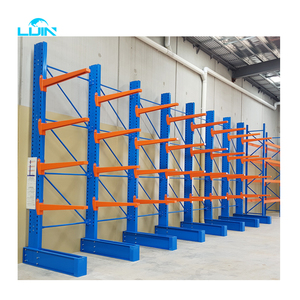
Factory Price Heavy Duty Cantilever Rack
Value-focused factory supply for steel bars, pipes and long profiles, with durable powder coating and layout-specific arm spacing.
View product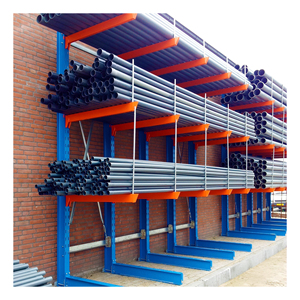
Industrial Single-Side Cantilever Rack
Wall-side storage for narrower aisles and efficient floor use, available with adjustable arms and custom base plates.
View product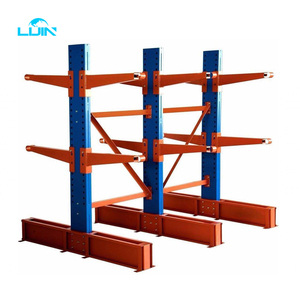
Heavy Duty Cantilever Racking System
Complete factory-and-warehouse system engineered for mixed long loads, with calculation support and export-ready packing.
View product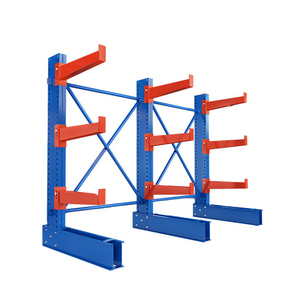
Structural Cantilever Rack for Timber Storage
Structural racking for timber yards and building-material warehouses; layout can be optimized to container dimensions.
View product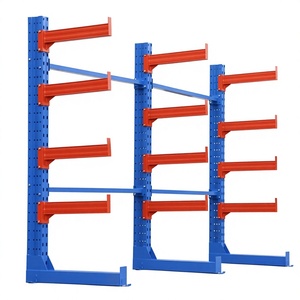
High-Capacity Steel Cantilever Rack
Heavy steel columns and adjustable arms for palletized and unpackaged long goods in high-capacity warehouse storage.
View product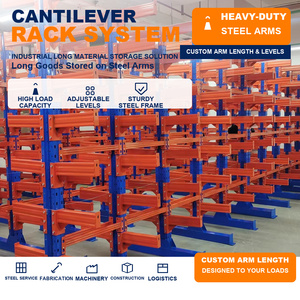
Adjustable Multi-Level Cantilever Rack
Flexible arm shelving for long-material warehouses where SKU lengths and load weights change over time.
View product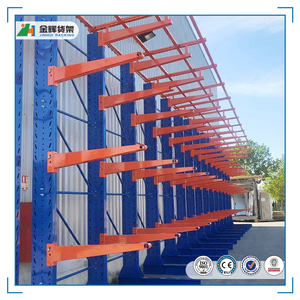
Cantilever Pipe & Aluminum Profile Rack
Cold-rolled steel, pipe, tube and aluminum extrusion storage with arm layouts designed to reduce load rolling.
View product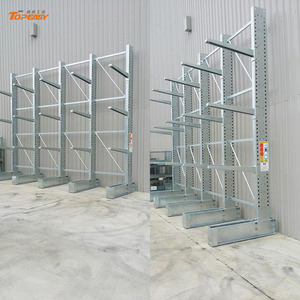
OEM Hot-Dip Galvanized Cantilever Rack
Corrosion-protected single or double-sided racking for humid, coastal or covered outdoor storage; OEM sizes available.
View productThe Engineering Anatomy of a Reliable Cantilever Racking System
Base & Anchor Design
The base plate, anchor size and concrete condition should be reviewed together. A strong upright cannot compensate for a weak floor connection.
Arm Pitch & Deflection
Load length, weight distribution and arm spacing determine deflection. Oversized arm spacing may look economical but can deform under point loads.
Surface Protection
Powder coating suits dry indoor warehouses; hot-dip galvanizing or enhanced pretreatment is preferable for coastal, humid or cold-chain sites.
Compliance & Safety
Ask for calculation assumptions referencing EN 15512, FEM 10.2.02, RMI MH16.1 or local seismic rules such as NCh 2369, E.030 and NSR-10 where applicable.
Cantilever Racking vs. Pallet Racking: Match the System to the Load
Long loads are not always best stored on pallets. Cantilever racking removes the need for a pallet opening, reduces damage risk and allows forklifts to approach from one or both sides. The comparison below helps procurement teams align storage density with handling reality.
| System | Best For | Density | Selectivity | Buyer Intent |
|---|---|---|---|---|
| Cantilever Racking | Timber, pipe, tube, profiles, steel bar | ●●●○○ | ●●●●● | Direct long-load access without pallets |
| Selective Pallet Racking | Uniform palletized goods, many SKUs | ●●●○○ | ●●●●● | Fast picking and standard pallet flow |
| Drive-In Racking | Homogeneous pallets, cold storage | ●●●●○ | ●○○○○ | High-density block storage |
| Radio Shuttle Racking | Deep lanes and semi-automated handling | ●●●●○ | ●●○○○ | Deep storage with FIFO or LIFO control |
A common mistake is to force long profiles onto pallet racking and rely on oversized decking. That approach often increases damage, slows handling and leaves hidden overload risk. Cantilever racking is purpose-built for the load geometry, so the arm and base design can be optimized instead of compromised.
What Buyers Will Demand From Cantilever Racking Suppliers by 2026
Procurement is shifting from “price per bay” to “verified total cost of ownership.” The buying questions that win internal approval are now about engineering evidence, climate fit, phase-based expansion and digital handover.
1. TCO Over Unit Price
Buyers will compare shipping cube, installation hours, repair risk, coating life and spare-part availability — not just the quotation total for steel.
2. Calculation & Drawing Transparency
RFQs will increasingly request load assumptions, arm-deflection checks, anchor plans and CAD layouts that local engineers can review and stamp.
3. Climate-Specific Finishes
Coastal, tropical and cold-chain warehouses need documented pretreatment and coating specifications, with galvanizing options for high-corrosion zones.
4. ESG & Recyclable Steel
Corporate buyers will ask for steel traceability, recyclable components, reduced packaging waste and factory environmental management evidence.
5. Modular CAPEX Planning
Instead of fitting every aisle at once, warehouses will phase uprights, arms and decking to match actual SKU growth and cash-flow cycles.
6. Faster, Cleaner RFQ Cycles
Winning suppliers will use standard RFQ templates, photo-based site checks and container-loading plans to shorten technical clarification time.
Where Cantilever Warehouse Racking Technology Is Heading
The next generation of cantilever systems will look similar from a distance but perform very differently. Higher-strength steel, smarter accessories and automation-ready layouts are reshaping the category.
Optimized Steel Sections
Higher-yield steel and refined upright profiles increase load capacity without simply adding weight, helping reduce freight cost per storage position.
Hybrid Arm Accessories
Adjustable stops, protective sleeves, pipe saddles and timber-support arms reduce product damage and improve handling safety for mixed loads.
Digital Inventory Interfaces
RFID labels, location tagging and barcode-ready beam labels help link cantilever storage positions to WMS workflows without full automation.
Automation-Ready Design
Layouts are being prepared for future crane, shuttle or AGV access, with clear aisle envelopes and interface points planned from the start.
Pre-Engineered Kits
Modular upright and arm kits shorten quotation and production cycles for distributors that need predictable stock and faster delivery.
Resilience Engineering
Seismic bracing, fire-service access and corrosion protection are increasingly bundled into the initial design rather than added after a risk review.
Inside the Factory: Why My Favorite Shelf Is a Trusted China Cantilever Racking Manufacturer
My Favorite Shelf Industrial Co., Ltd. is not a marketplace reseller. We have manufactured warehouse racking and automated storage systems since 1997, with an annual steel processing capacity of approximately 60,000 tons. Our production base covers profile forming, cutting, welding, pre-treatment, powder coating, inspection and trial assembly — the controls that determine whether a cantilever rack arrives square, straight and ready to install.
Our municipal-level technical R&D center holds more than 70 national patents and software copyrights covering racking, stacker cranes, conveyors, shuttle carriers and warehouse control software. Production is managed under ISO 9001, ISO 14001, ISO 45001 and ISO 10012 measurement management systems, and our automated products carry CE certification where applicable. For buyers who need an audit trail, these certifications are not decoration; they are procurement evidence.
Our engineering team is led by a professor-level senior engineer and doctoral tutor who co-authored recognized references on automated warehouse design and logistics distribution center management technology. That expertise is applied to standard cantilever projects as well as custom long-load warehouses, including reinforced uprights, special base plates, hot-dip galvanized finishes and project documentation for local engineers.
What This Means for Your Project
You get a factory that can answer engineering questions before the order, produce the steel after the order and support the installation after shipment.
- Single or double-sided cantilever layouts
- Powder-coated or hot-dip galvanized finish
- Custom arm spacing and load ratings
- Container-optimized packing plans
- Drawing review before mass production
- Spare parts and after-sales support
Where Cantilever Racking Delivers the Highest Return
Timber & Building Materials
Lumber, engineered wood, door frames and long façade materials can be stored on wide arms with timber-friendly supports, reducing marking and re-handling.
Pipe, Tube & Aluminum Profiles
Saddles, dividers and protective arm covers keep round or finished surfaces stable. Arm spacing can be set to prevent sagging across long bundles.
Machinery & Metal Fabrication
Steel bar, extrusion, jig sections and fabricated profiles stay accessible by forklift or overhead crane, supporting both production and dispatch zones.
Cantilever Warehouse Racking Procurement FAQ
What loads and lengths can a cantilever rack handle?
Most project ranges run from light profiles to heavy steel bundles. The practical limit depends on upright section, arm size, arm spacing and floor anchors. Send the maximum load per arm, load length and center of gravity so the factory can size the system rather than guess.
Should I choose single-sided or double-sided cantilever racking?
Single-sided racking is efficient against a wall or column line and suits narrow aisles. Double-sided racking increases storage density and is better for central floor positions where forklifts can approach from both sides. The decision should follow your layout, not a catalogue default.
How do I calculate the right arm spacing?
Arm spacing depends on load length, stiffness, bundle weight and acceptable deflection. For long timber or pipes, more arms may be needed even if the total weight is below the arm rating. A professional supplier should ask for a load drawing or photo.
Which finish is best for humid or coastal warehouses?
Standard epoxy-polyester powder coating suits dry indoor sites. For humid, coastal or cold-chain warehouses, specify enhanced pretreatment or hot-dip galvanizing. Confirm coating thickness, salt-spray expectation and touch-up procedures before production.
Can you provide drawings for seismic zones?
Yes. For Chile, Peru, Colombia and other seismic regions, calculations can reference local requirements such as NCh 2369, E.030 and NSR-10 where applicable. Reinforced uprights, bracing, base plates and anchor specifications should be reviewed by your local engineer.
How is cantilever racking packed for container shipping?
Uprights, arms, bracing and base plates are nested and steel-strapped to reduce wasted container space. Export documents typically include commercial invoice, packing list, bill of lading, certificate of origin and, on request, material and test reports.
Request a Factory-Direct Cantilever Racking Proposal
To receive a useful quotation instead of a generic price list, send the building length × width × clear height, maximum load length and weight, load per arm, forklift type, destination port, finish requirement and target installation date. Our engineers will review the load geometry and recommend a single-sided or double-sided layout with an estimated pallet or storage-position count.
- Building dimensions and column grid
- Long-load length, weight and center of gravity
- Required arm spacing and levels
- Indoor, coastal or cold-chain environment
- Destination port and container preference
- Project schedule and installation support needs
Talk to a Cantilever Racking Engineer
Share your load details and we will reply with a practical layout direction, material recommendation and export-packing considerations. For urgent projects, include photos of the current storage area and the most common load bundles.
Send an Inquiry