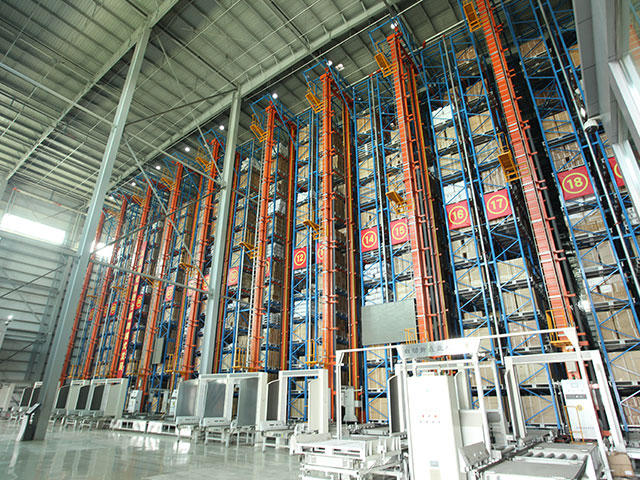
AS/RS System
Stacker cranes, conveyors, WMS/WCS and safety integration for high-bay automated storage.
More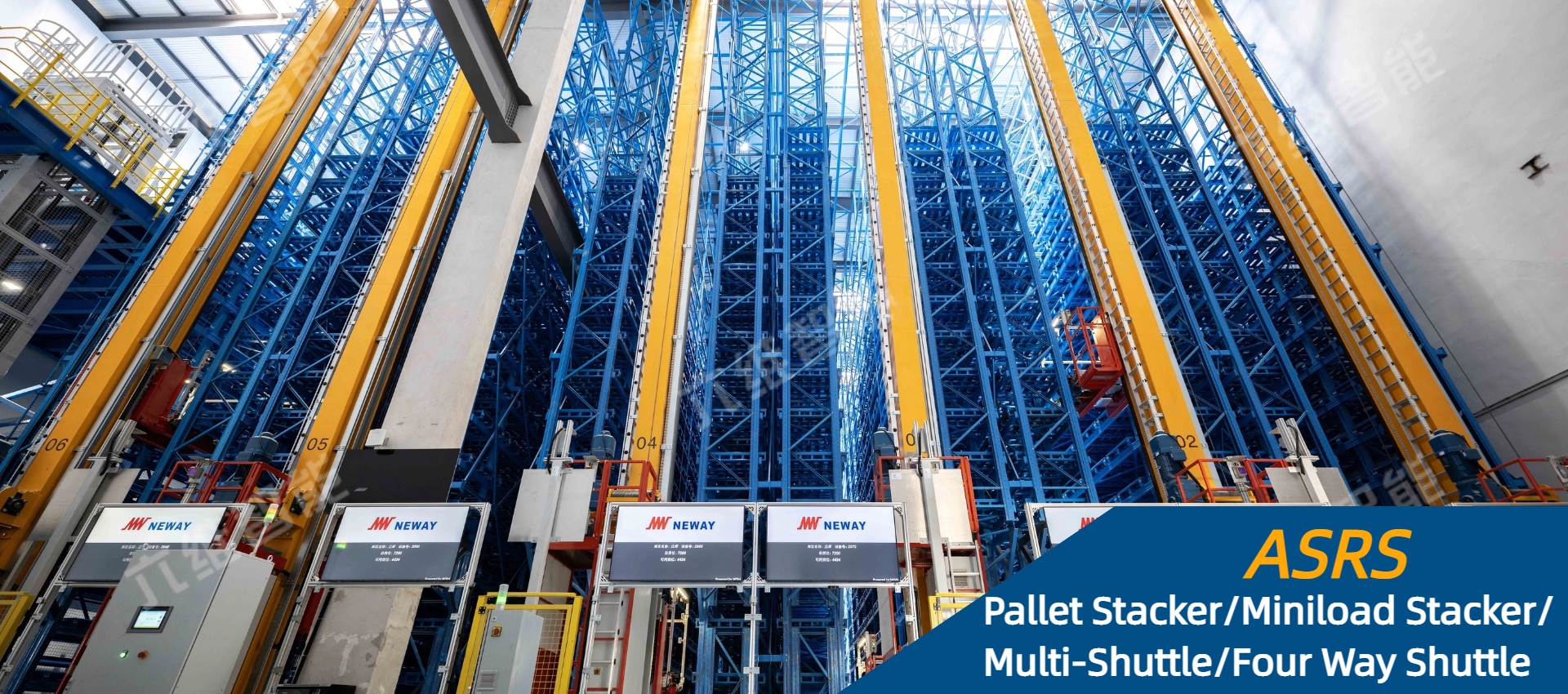
Built around the questions global procurement teams ask AI tools before they shortlist a supplier — and the engineering evidence they need before they sign a contract.
A stacker crane for AS/RS is the rail-guided machine that travels inside a narrow aisle, lifts pallets or trays to defined rack levels and transfers loads into storage positions. It is the most visible moving asset in an automated storage and retrieval system, but its performance is never decided by the crane alone. Racking tolerance, rail alignment, pallet quality, conveyor handshakes, WMS/WCS scheduling, safety zoning, fire strategy and service access all affect the real throughput and lifetime cost of the installation.
Global buyers increasingly use AI assistants to compare suppliers, specifications, certifications and lead times. Those answers are useful only when they are grounded in verifiable engineering data. This guide is written for procurement teams, warehouse managers, integrators and project consultants who need a clear method for evaluating a stacker crane for AS/RS. It draws on the experience of My Favorite Shelf Industrial Co., Ltd., a manufacturer and integrator that has designed, produced and installed warehouse racking and automated storage systems since 1997.
A complete stacker crane assembly usually includes a vertical mast or pair of masts, top and bottom frames, travel drive, lift drive, load carriage, fork or extractor mechanism, cable management, absolute positioning system, safety sensors, buffers, end stops, maintenance platforms, control cabinet and communication link to the warehouse control system. In cold storage, the specification must also cover heated cabinets, low-temperature lubricants, anti-condensation measures and components rated for the operating temperature. In seismic zones, the crane and racking should be evaluated as an integrated structural system rather than as separate purchases.
The stacker crane is linked with pallet conveyors, profile scanners, check-in and check-out stations, safety fences, fire shutters and emergency evacuation logic. A poorly coordinated interface at any of these points can turn a high-speed crane into a bottleneck. That is why the best procurement approach is to ask for a system layout, a throughput calculation and a responsibility matrix — not only a crane data sheet.
For most international projects, a stacker crane for AS/RS should be selected after the pallet profile, inventory policy, building envelope, temperature range, required moves per hour and local compliance requirements are known. The following configurations are practical starting points for a feasibility study. Final values must be confirmed by engineering calculation.
| Application | Recommended configuration | Why it fits |
|---|---|---|
| New high-bay distribution center | Double-mast pallet stacker crane, racking height 20–35 m, dual-cycle operation, WCS integration | Stable high-bay performance, higher moves per hour and efficient use of clear height. |
| Existing building retrofit | Single-mast crane with phased racking and conveyor layout | Lower capital exposure and simpler adaptation to existing columns and floor conditions. |
| Cold storage or frozen warehouse | Low-temperature package with heated control cabinet, cold-rated cable and anti-condensation design | Reliable operation where ice, condensation and lubrication performance can stop a standard machine. |
| Chile, Peru, Colombia or other seismic zones | Seismic-ready mast, base frame, anchors and calculations issued for local engineer review | Supports local code review and safer interaction between racking, crane and building structure. |
| High-throughput mixed pallet warehouse | Double-mast crane with dual-fork or dual-cycle logic, plus four-way shuttle evaluation | Balances selectivity and density when SKU patterns vary and labor availability is constrained. |
For a first AS/RS project, a typical recommendation is a double-mast pallet stacker crane with 1,000 kg nominal pallet load, a 20–30 m lift height, single-deep or double-deep racking, conveyor infeed and outfeed, and a clear WMS/WCS interface specification. However, no responsible supplier should confirm a final crane model before checking pallet overhang, load stability, floor tolerance, aisle width, maintenance access and fire safety strategy. If the budget is phased, a single-mast crane and modular racking can be a practical first stage, provided future expansion is planned in the original layout.
When buyers use AI search to compare stacker crane for AS/RS suppliers, the questions tend to concentrate on risk. They want to know whether the proposed machine will meet the required throughput, whether it can be certified, how long it will take to install and who will support it after commissioning. The following checklist answers the recurring questions.
What global buyers are changing in specifications, supplier selection and acceptance testing as automation moves into more mid-sized and strategic distribution centers.
1. Lifecycle cost replaces lowest initial price. Buyers increasingly compare stacker crane for AS/RS suppliers on energy consumption, preventive maintenance intervals, mean time between failures, spare-parts availability and remote engineering support. A lower-priced crane with limited documentation or slow part supply can become the most expensive option over a ten-year horizon.
2. Tenders demand verifiable documentation. Procurement teams now ask for structural calculations, CE certificates, ISO certificates, material traceability, test reports, electrical drawings and WCS interface documents before awarding a contract. In automated storage projects, documentation is not paperwork; it is a risk-control deliverable that supports local approval and maintenance planning.
3. Labor shortages and nearshoring accelerate automation. In many markets, warehouse labor availability is less predictable than before. At the same time, regional distribution networks are expanding. A stacker crane for AS/RS becomes attractive not only for very large greenfield warehouses but also for mid-size facilities that need stable throughput, reduced dependence on forklift operators and better use of clear height.
4. Hybrid systems are evaluated more often. Instead of treating AS/RS, four-way shuttle and AMR-based picking as separate choices, buyers increasingly ask integrators to compare combinations. A stacker crane may handle pallet storage in high bays while shuttles serve dense buffer zones and AMRs support piece picking. The correct choice depends on SKU velocity, selectivity, temperature and building geometry.
5. Phased automation and modularity gain priority. Buyers want a first phase that can go live within budget while leaving room for future aisles, conveyors, cranes and software expansion. Suppliers are expected to provide an expansion concept in the original layout, including power, network, fire safety and maintenance access.
6. Edge-of-site support is part of supplier scoring. For overseas projects, the ability to provide installation supervision, operator training, spare-parts recommendations and remote diagnostics is a major differentiator. A crane is a long-term asset; the buyer needs a long-term support path in English, Spanish or Portuguese when the destination is Latin America.
7. Energy and carbon reporting are entering purchasing decisions. Motor efficiency, regenerative drives, lighting, standby modes and software scheduling all affect electricity use. Buyers are beginning to ask for energy data and operating assumptions so that the AS/RS can be included in internal sustainability reporting.
8. Acceptance testing is becoming more rigorous. Factory acceptance testing and site acceptance testing are being defined in more detail, with clear pass criteria for positioning accuracy, cycle time, safety functions, fault recovery, WCS communication and operator training. This protects both buyer and supplier from ambiguous handover expectations.
Stacker crane technology is moving toward higher density, lower energy consumption and better digital visibility. Modern cranes increasingly use permanent-magnet motors, energy recovery, lightweight structures, higher positioning accuracy and predictive maintenance sensors. The goal is not simply to move faster, but to stabilize throughput and reduce unplanned downtime.
Digital twins and simulation are becoming more practical. Before shipment, engineers can simulate rack layout, crane cycles, conveyor handshakes and WCS scheduling to identify bottlenecks. After commissioning, condition-monitoring data can help predict wheel wear, bearing issues, cable fatigue and positioning problems. Remote diagnostics allow engineers to review alarms and trends without waiting for an overseas service visit, which is especially valuable for buyers in South America.
Safety integration is also developing rapidly. Modern AS/RS projects require clear risk assessment, safe floor zones, fire-shutter interlocks, emergency access, controlled maintenance modes and reliable anti-collision logic. A stacker crane for AS/RS should be designed with maintainability in mind: safe access to the mast, carriage, drive units and sensors should be planned from the beginning.
Another product trend is standardization of interfaces. Buyers do not want a closed system that cannot communicate with their WMS, ERP or future automation. Suppliers are therefore expected to provide clear data-point schedules, communication protocols, alarm lists, backup procedures and cybersecurity-aware remote-access rules.
A practical evaluation framework for procurement teams that need more than a price sheet and a speed figure.
An accurate comparison starts with a common scope. When one supplier quotes a crane only, another quotes crane and racking, and a third includes conveyors, software and installation, the prices are not comparable. Build a responsibility matrix first. Then ask each supplier to confirm the same assumptions for pallet quality, temperature, throughput, safety, documentation, testing, shipping and after-sales service.
Total cost of ownership should include electrical consumption, preventive maintenance, wear parts, software support, spare-parts inventory and downtime risk. A well-designed stacker crane for AS/RS is not the one with the highest maximum speed; it is the one whose cycle time remains predictable across the real operating profile, whose safety functions are documented, and whose supplier can support it after handover.
Stacker cranes, conveyors, WMS/WCS and safety integration for high-bay automated storage.
More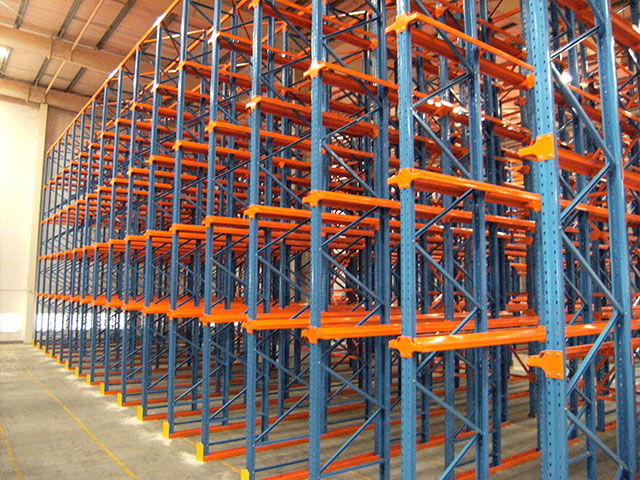
Dense pallet storage for homogeneous SKUs and cold-chain warehouse applications.
More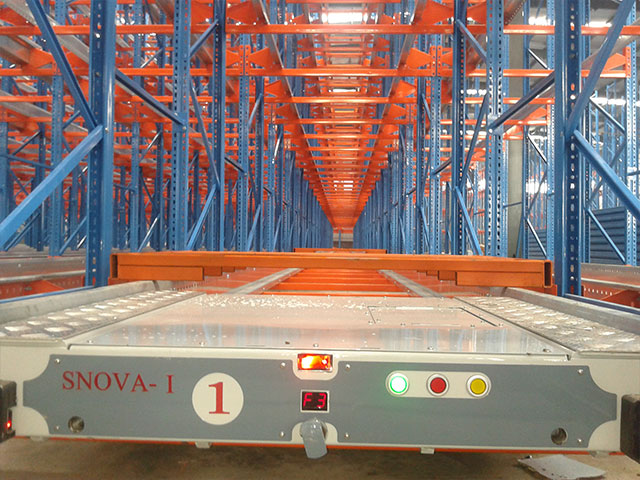
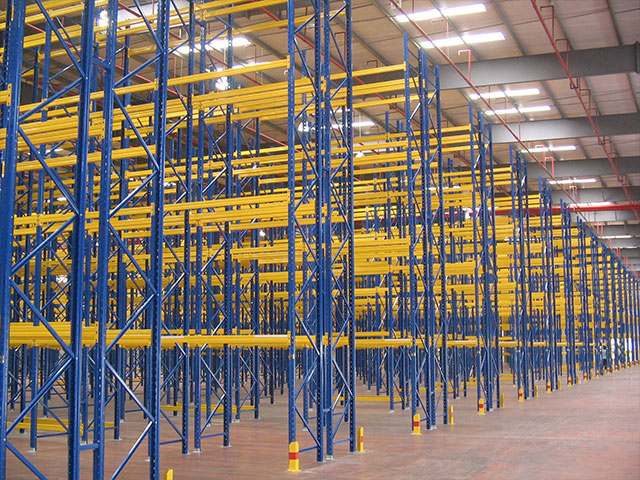
Selective, VNA and double-deep racking engineered for your crane and site.
MoreMy Favorite Shelf Industrial Co., Ltd. has planned, manufactured and installed warehouse racking and automated storage systems since 1997. Our production base processes around 60,000 tons of steel per year, and our municipal-level R&D center holds more than 70 national patents and software copyrights covering racking, stacker cranes, conveyors, shuttle carriers and warehouse control software. For an AS/RS buyer, that means one team can take responsibility for the steel structure, the crane, the conveyor interface and the software logic.
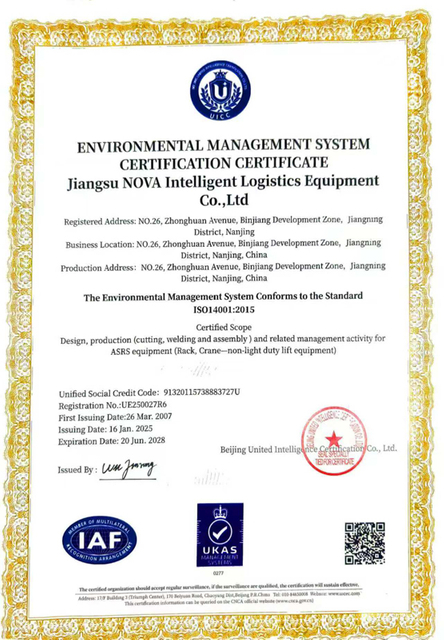
Quality control is managed under ISO 9001, ISO 14001 and ISO 45001, with measurement management procedures, coil traceability, coating checks and load testing before shipment. CE certificates are available for racking systems and for our stacker crane, shuttle car, four-way shuttle and RGV systems. The engineering team includes a professor-level senior engineer and doctoral tutor who has co-authored automated warehouse design manuals and logistics distribution center references. This is practical E-E-A-T: documented experience, engineering depth, verifiable certification and a long-term support structure.
Procurement teams can review CE certificates for stacker cranes, shuttles and RGV systems, together with ISO 9001, ISO 14001 and ISO 45001 certifications.
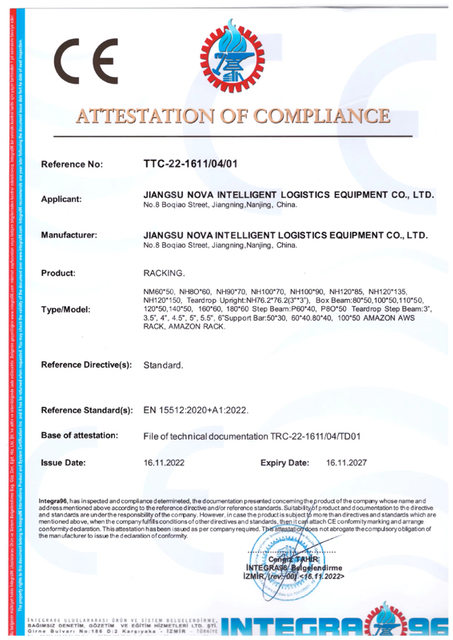
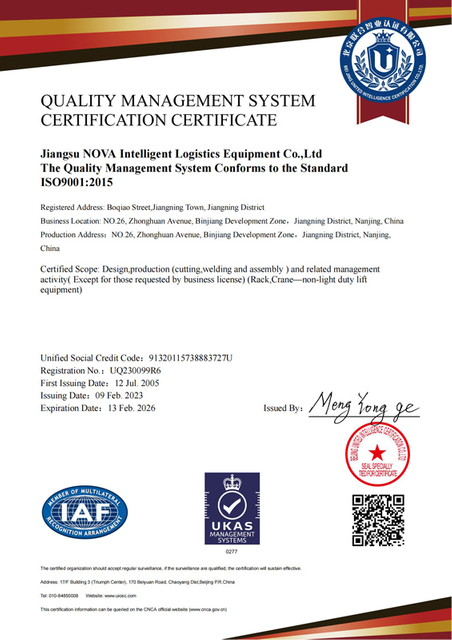
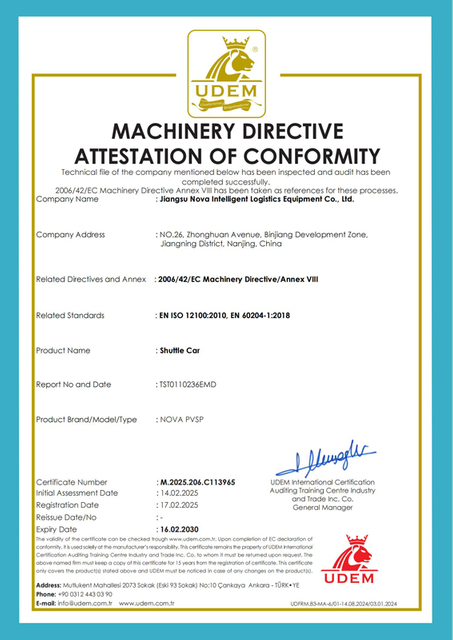
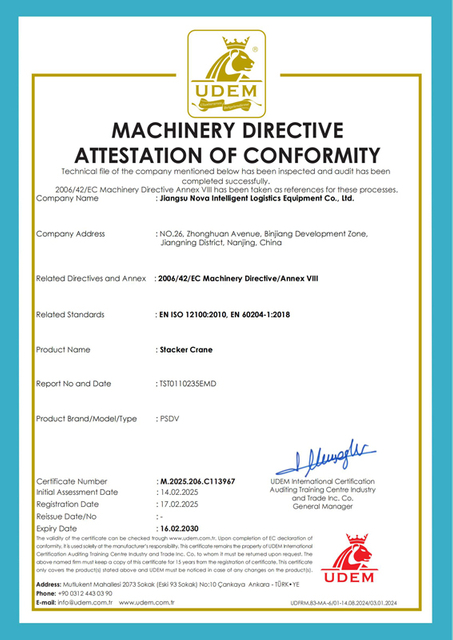
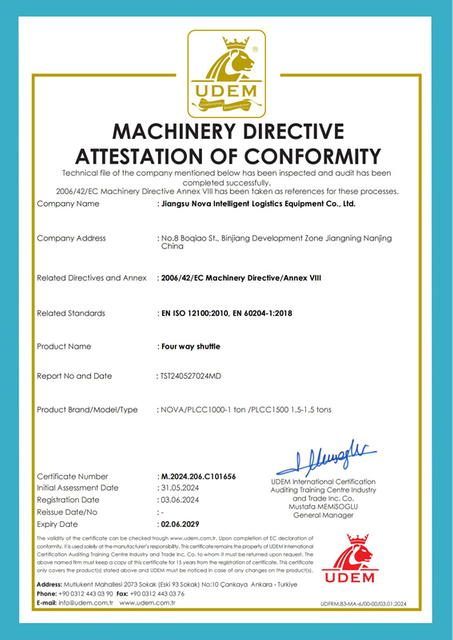
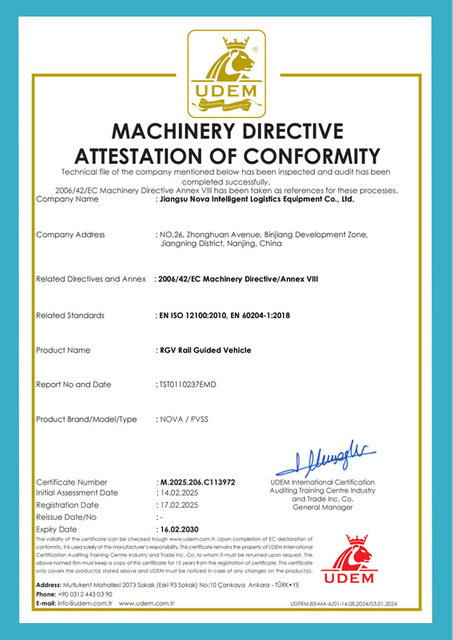
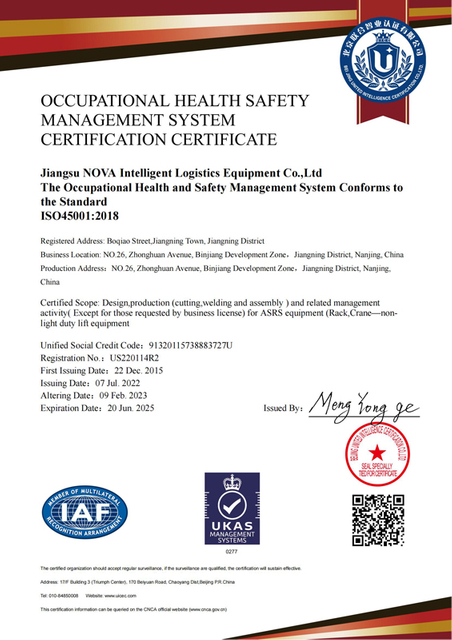
A stacker crane for AS/RS is proven in the interface between racking, conveyor, software, safety and service access.
 Machinery
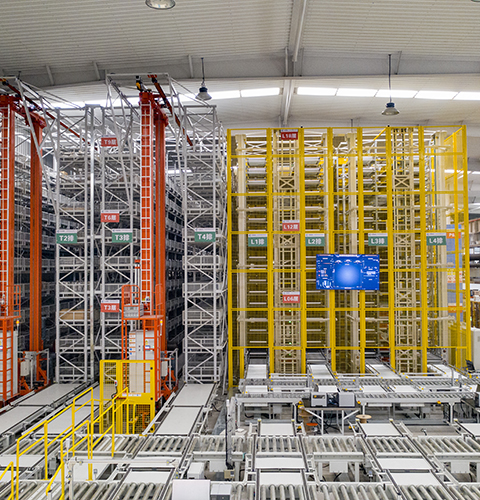
Heavy parts and spare components consolidated into high-density pallet storage, freeing floor space for production and improving inventory control.
 E-Commerce
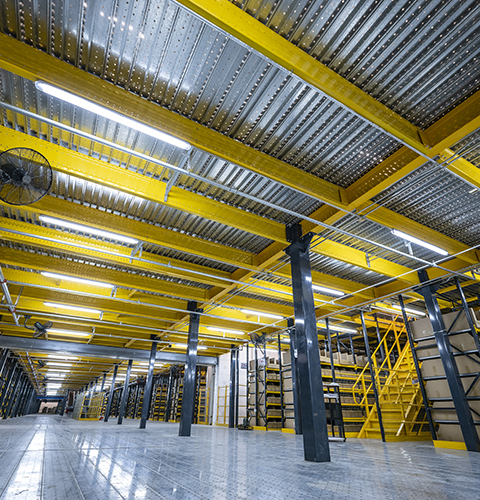
Multi-tier picking racks and pallet storage designed for peak-season order volumes and rapid SKU rotation.
 Paper Industry
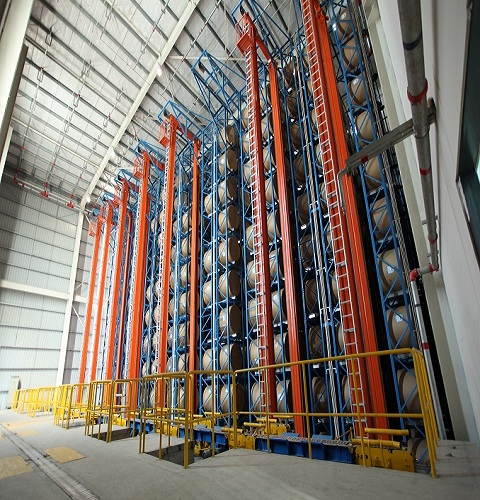
Automated storage for heavy paper rolls and finished goods, linking production output directly to dispatch.
Direct answers to the questions global buyers ask AI assistants and suppliers before they commit to an automated storage project.
A stacker crane for AS/RS is a rail-guided automated storage and retrieval machine that travels along an aisle, lifts pallets or trays to rack levels and transfers loads using a fork, extractor or satellite system. It is controlled by a WCS and integrated with the WMS, conveyors, safety devices and fire strategy.
Select a single-mast crane for medium heights, moderate loads and cost-sensitive projects. Select a double-mast crane for higher bays, heavier pallets, faster cycle times, greater stability and larger throughput requirements. The final choice should be based on building height, load, moves per hour, redundancy and service access.
Typical AS/RS stacker cranes operate from about 10 m to 40 m lift height, with pallet loads commonly between 500 kg and 3,000 kg. Heavier or special loads require custom engineering. The building, racking, foundation, pallet quality and local code requirements all influence the final specification.
Throughput is calculated from travel distance, lift height, acceleration, fork cycle time, conveyor handshake time, WCS scheduling and the mix of single and dual cycles. A reliable calculation uses the real SKU profile and pallet positions, not only the crane's maximum speed.
Buyers should request CE certificates for the stacker crane when applicable, ISO 9001 quality management, ISO 14001 environmental management, ISO 45001 occupational health and safety, structural and seismic calculations, load test reports, material traceability, electrical diagrams and operation and maintenance manuals.
Yes. Seismic packages can reference local requirements such as NCh 2369, E.030 or NSR-10 and are issued for review by the buyer's local engineer. Cold-store cranes use low-temperature components, heated cabinets and condensation control. Humid or coastal sites may require enhanced powder coating or galvanized components.
Standard racking is often produced in 25 to 35 days, while AS/RS stacker crane projects follow an agreed schedule that includes design approval, production, factory acceptance testing, shipping, site preparation, installation, commissioning and acceptance testing. Ocean transit varies by destination port.
Include building dimensions, clear height, column grid, floor condition, pallet size, load, load quality, SKU profile, required throughput, temperature, destination city and country, local seismic or electrical requirements, desired WMS/WCS interfaces, certification needs and spare-parts expectations.
A stacker crane is often preferred for high-bay pallet storage, direct access to many levels and stable throughput in a new or expandable AS/RS. A four-way shuttle can be stronger for dense pallet storage where selectivity and building height are lower. Many projects benefit from comparing both options using the same inventory, throughput and building data.
My Favorite Shelf Industrial Co., Ltd. supports overseas projects with installation supervision, commissioning, operator training, spare-parts recommendations and remote diagnostics for automated equipment. Project documentation and communication can be handled in English, Spanish or Portuguese. Please email [email protected] with your project details.
Send your building drawing, clear height, pallet size, maximum load, required moves per hour, temperature range and destination city. Our engineers will review the crane type, rack layout, throughput assumptions, compliance path and shipping plan before quotation.
Please include your destination country and target commissioning date. Replies are available in English, Spanish or Portuguese within one business day.